25-day residential RYT-200 certified program at Maunvan Ashram · Rishikesh, India · Hatha & Ashtanga · Max 12 students · All-inclusive
Yoga Alliance RYT-200 Registered · Small Groups Max 12 · All-Inclusive · Rolling Monthly Intake
200 Hour Yoga TTC in Rishikesh, India
The 200 Hour Yoga Teacher Training in Rishikesh at Maunvan is a 25-day residential, all-inclusive program leading to a Yoga Alliance RYT-200 certification. It covers Hatha yoga, Ashtanga, Pranayama, Anatomy, Philosophy, and Teaching Methodology — held at a traditional ashram in Tapovan, Rishikesh, India. Groups are capped at 12 students. Monthly batches start from $1,050.
Maunvan's 200 Hour Yoga Teacher Training in Rishikesh is a 25-day residential program held at our ashram on a forested ridge above the Ganga valley. It is designed for dedicated practitioners who want to deepen their personal yoga practice and gain the internationally recognised credentials to teach. The course covers Hatha yoga, Ashtanga, Pranayama, Anatomy and Physiology, Yoga Philosophy, Teaching Methodology, and Sanskrit — taught in a structured daily curriculum by experienced resident teachers.
This is a Yoga Alliance RYS 200 registered program. Upon successful completion you receive a certificate that allows you to register as an RYT-200 — the internationally accepted standard for professional yoga teachers. Groups are capped at a maximum of 12 students so that each participant receives genuine personal attention throughout the entire 25 days. Monthly batches run all year.
For anyone seriously considering a 200 Hour Yoga TTC in India, Rishikesh is the right starting point — and within Rishikesh, a small ashram-based program like Maunvan is a fundamentally different experience from a large commercial school. India is where yoga originated and where its living tradition has been continuously taught for thousands of years. Doing your 200 Hour TTC here is not tourism — it is studying the subject in the place it comes from, with teachers whose practice is rooted in that tradition.
What is the 200 Hour Yoga Teacher Training at Maunvan?
The 200 Hour Yoga Teacher Training is the globally recognised entry point for anyone who wants to teach yoga professionally. It is the foundational qualification — before you can do a 300 Hour advanced training or specialise in any area of yoga, you need a solid 200 Hour certificate from a credible school. Maunvan's 200 Hour TTC in Rishikesh meets and exceeds the Yoga Alliance standards for this certification while staying true to the classical Indian tradition from which yoga originates.
The course runs for 25 continuous days. You live at the ashram for the entire duration — rising before sunrise each morning, moving through a structured daily curriculum, studying independently in the afternoon, and gathering for satsang in the evening. This immersive structure is not incidental to the training: you cannot genuinely learn to teach yoga by attending weekend workshops. A teacher training requires sustained practice, sustained study, and the kind of understanding that only emerges from living inside a practice day after day for a full month.
At Maunvan, the training is kept deliberately small. A maximum of 12 students per batch means your teachers know you — your body, your progress, your specific challenges — and can teach you accordingly rather than teaching to a generic group. This is the difference between a real training and a mass-produced certificate program. Our teachers are not visiting instructors on a rotation: they are resident at the ashram and available throughout the 25 days.
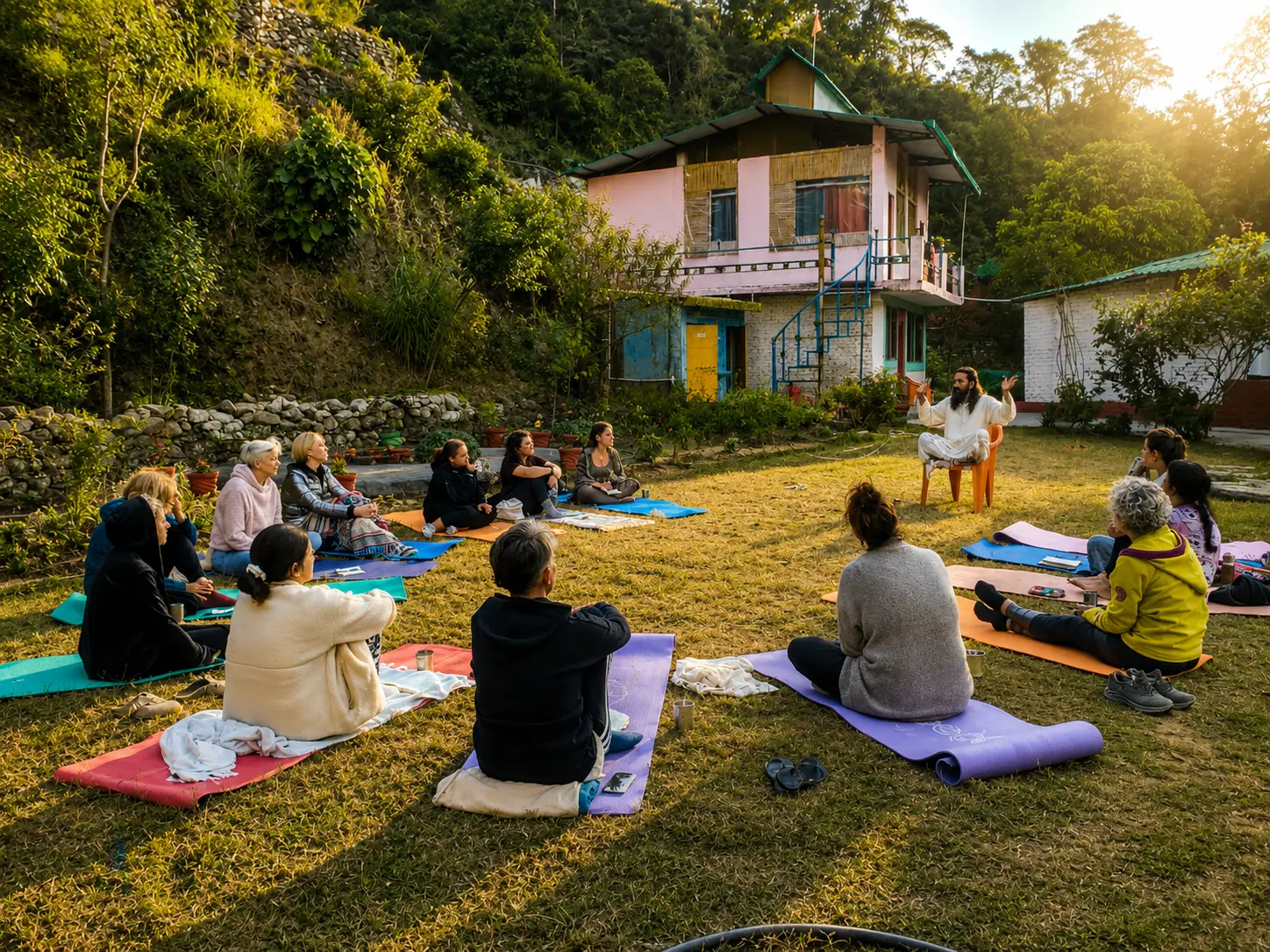
The setting matters too. Rishikesh sits in the Himalayan foothills at the place where the Ganga descends from the mountains into the plains — it has been the centre of classical yoga teaching in India for generations. Maunvan is not in the tourist strip of central Rishikesh; it sits in a forested area above the valley, genuinely quiet, genuinely natural. The mornings here — rising to practice before sunrise with Himalayan ridges catching the first light — are a significant part of why the training works as deeply as it does.
Course Dates & Fees 2026 / 2027
New batches begin on the first Monday of each month throughout the year. The course runs for 25 consecutive days. Maximum 12 students per batch. Book early — peak-season batches (October through March) fill several months in advance.
Start Date
End Date
Single Room
Sharing Room
07 Sep 2026
01 Oct 2026
$1,200
$1,050
05 Oct 2026
29 Oct 2026
$1,200
$1,050
02 Nov 2026
26 Nov 2026
$1,200
$1,050
07 Dec 2026
31 Dec 2026
$1,200
$1,050
04 Jan 2027
28 Jan 2027
$1,200
$1,050
01 Feb 2027
25 Feb 2027
$1,200
$1,050
01 Mar 2027
25 Mar 2027
$1,200
$1,050
05 Apr 2027
29 Apr 2027
$1,200
$1,050
03 May 2027
27 May 2027
$1,200
$1,050
07 Jun 2027
01 Jul 2027
$1,200
$1,050
06 Sep 2027
30 Sep 2027
$1,200
$1,050
All fees are all-inclusive — 25 nights accommodation, three sattvic vegetarian meals per day, all teaching sessions, course materials, and Yoga Alliance registration support. No hidden extras. Best time for the TTC: October to March for cool, clear Himalayan weather ideal for intensive practice.
Daily Schedule
The daily schedule during the 200 Hour TTC is intensive and structured. Every hour has a purpose. The structure itself is part of the education: learning to live in a yogic daily rhythm — early rising, regular practice, disciplined study, sattvic eating — is inseparable from learning to teach yoga. The schedule runs six days a week with one day of rest.
05:30 AM
Wake Up
Rise before sunrise. Wash, dress in practice clothes, and move to the shala in the Himalayan morning air.
06:00 AM
Pranayama & Meditation
90 minutes of guided classical pranayama — Nadi Shodhana, Kapalabhati, Ujjayi — followed by 20 minutes of silent seated meditation. The foundational session of the entire day.
07:30 AM
Hatha / Ashtanga Yoga Practice
90 minutes of asana practice — Hatha on alternating days, Ashtanga primary series on others. Detailed alignment instruction, hands-on adjustments, breath awareness throughout.
09:00 AM
Breakfast
Warm sattvic vegetarian meal prepared fresh each morning — nourishing, easily digestible, Ayurvedically appropriate for post-practice feeding.
10:00 AM
Yoga Anatomy & Physiology
Two hours of applied anatomy study — musculoskeletal system, joint mechanics, the nervous system, breath physiology, injury prevention, and safe adjustment principles.
12:00 PM
Yoga Philosophy / Sanskrit
Study of the Yoga Sutras, the Bhagavad Gita, the eight limbs of yoga, and Sanskrit terminology. Taught through discussion and inquiry rather than rote lecture.
01:00 PM
Lunch & Rest
The main sattvic meal of the day. Followed by free time — rest, self-study, journaling, or quiet walks through the ashram grounds.
02:30 PM
Teaching Methodology / Workshop
Practical teaching sessions — sequencing workshops, peer teaching practice, cueing technique, adjustment methodology, class planning, and observed teaching with detailed feedback.
04:00 PM
Afternoon Yoga Practice
Yin yoga, restorative practice, or Yoga Nidra — the quieting complement to the morning's dynamic session. Deepens the asana understanding from a different angle.
06:00 PM
Self-Study / Reading
Structured personal study time — reviewing notes, reading the course texts, working on teaching sequences, and preparing for the following day.
07:00 PM
Dinner
Light sattvic evening meal. Warm, nourishing, and easy on the digestion before sleep.
08:00 PM
Satsang / Mantra / Discussion
Evening gathering — mantra chanting, philosophical discussion, Q&A with teachers, or guided journaling. The community dimension of the training.
10:00 PM
Lights Out
Early to bed to support the 5:30 AM rising. Quality sleep is as much a part of the training as the practice sessions.
Why Do Your 200 Hour Yoga TTC in India — and in Rishikesh Specifically?
When people search for a 200 Hour Yoga TTC, they quickly find programs in Bali, Thailand, Europe, and dozens of other locations. So why do so many serious yoga practitioners specifically choose a 200 Hour Yoga Teacher Training in India? And once they decide on India, why does Rishikesh emerge as the clear centre for this kind of study?
The answer is not marketing. It is geography, history, and the nature of the tradition itself.
🇮🇳
Yoga Was Born in India
The Yoga Sutras of Patanjali, the Bhagavad Gita, the Hatha Yoga Pradipika — the foundational texts of the tradition you are studying were written and practiced in India. When your teacher explains the eight limbs of yoga or leads you through a traditional pranayama sequence, they are drawing on a living lineage that has been passed down here continuously. Studying yoga in India is not the same as studying it elsewhere — the context is real, not reconstructed.
🏔
Rishikesh: The World Capital of Yoga
Rishikesh is not called the yoga capital of the world for promotional reasons — it has been the gathering place for yogis, sadhus, and seekers for centuries. The Ganga descends from the Himalayas here. The air, the pace, the presence of serious practitioners and teachers, the temples and ghats and forest paths — all of it creates an environment that is genuinely conducive to the kind of deep, sustained practice that a 200 Hour TTC demands. You cannot manufacture this elsewhere.
💰
Exceptional Value Without Compromise
A 200 Hour Yoga TTC in Rishikesh, India costs a fraction of what the same program costs in Western countries or popular Southeast Asian destinations — while the quality of teaching, the depth of the tradition, and the immersiveness of the experience is simply not comparable. At Maunvan, the all-inclusive course fee starts at $1,050 for 25 days. A comparable program in Europe or the US typically costs three to five times that amount, with far less immersion and far larger class sizes.
🧘
Teachers Who Practice What They Teach
In Rishikesh, yoga is not a fitness industry — it is a way of life that many teachers here have followed for decades, not years. At Maunvan, our resident teachers were not trained in a 200 Hour weekend certification and then hired to run courses. They have practiced and studied within the classical Indian tradition for a very long time. That depth shows immediately in how they teach, in the questions they can answer, and in the kind of practitioner you become under their guidance.
🌄
The Immersive 25-Day Structure
A 200 Hour TTC in India is designed as a complete immersion — you do not commute to a studio and go home in the evenings. You live at the ashram, eat sattvic food, practice before sunrise, study through the morning, and let the rhythm of this place reshape your understanding of what yoga actually is. This total-immersion format produces a fundamentally different quality of learning than any non-residential program, regardless of how many hours it claims to cover.
📜
A Certificate With Genuine Credibility
Yoga students worldwide recognise the difference between a certificate from a school in Rishikesh with deep roots in the Indian tradition and a certificate from a fitness instructor who completed a fast-track program. A 200 Hour Yoga Teacher Training in Rishikesh India from a Yoga Alliance Registered School carries weight because the location itself signals that the teaching is authentic. Maunvan is RYS 200 registered — your certificate qualifies you to register as an RYT-200 with Yoga Alliance.
The short answer: if you are going to invest 25 days and a meaningful amount of money in a 200 Hour Yoga TTC, doing it in Rishikesh, India at a small traditional ashram like Maunvan gives you the deepest possible return on that investment — in terms of what you learn, how you learn it, and who you become in the process.
What Will You Learn? The 200-Hour Curriculum
The 200 Hour TTC curriculum at Maunvan covers all six core subject areas required by Yoga Alliance for the RYT-200 credential, taught through daily scheduled sessions over the 25-day program. The course is structured to build from foundational understanding to practical teaching application.
A
Asana Practice (Hatha & Ashtanga)
Comprehensive study of classical Hatha yoga postures and the Ashtanga primary series. Daily practice sessions with detailed alignment instruction, hands-on adjustments, and systematic progression. You learn each asana in depth — not just the shape, but the breath, the drishti, the energetic intention, and how to teach it safely to students of varying bodies and experience.
P
Pranayama (Classical Breathwork)
Daily 90-minute pranayama sessions covering Nadi Shodhana, Kapalabhati, Ujjayi, Bhastrika, Sitali, Sitkari, and Bhramari. You study the physiological effects of each technique, the contraindications, and how to introduce pranayama progressively to students at different stages of practice. Pranayama is taught as a central practice, not an add-on.
An
Anatomy & Physiology
Applied anatomy for yoga teachers — the musculoskeletal system, joint mechanics, the nervous system and breath, and how individual anatomical differences affect posture practice. You study common injuries in yoga, safe adjustments, and how to modify asana for students with limitations. This is practical, teaching-oriented anatomy: not a medical course but a teacher's working knowledge of the body.
Ph
Yoga Philosophy & Sutras
Study of the Yoga Sutras of Patanjali, the Bhagavad Gita, and the foundational texts of the classical yoga tradition. The eight limbs of yoga, the concept of the kleshas, the nature of the mind, and the practical application of philosophical understanding to daily life and teaching practice. Sessions are taught through discussion, not rote learning — the goal is genuine understanding that informs how you teach.
TM
Teaching Methodology
The practical craft of teaching yoga — how to sequence a class, how to give clear verbal cues, how to offer physical adjustments safely, how to read a room and adapt on the fly. You practice teaching your peers from week two onwards, with detailed feedback from the resident teachers. By the end of the 25 days you have led multiple full classes and received structured assessment of your teaching.
S
Sanskrit & Mantra
Practical Sanskrit for yoga teachers — the names and pronunciations of asanas, pranayama techniques, and key philosophical terms. Introduction to mantra and chanting as part of the traditional practice. You do not need to become a Sanskrit scholar, but a working knowledge of the language of yoga gives your teaching a depth and authenticity that generic English-only training cannot provide.
What's Included in the 200 Hour TTC Fee?
The course fee is fully all-inclusive. One payment covers everything for the entire 25 days. There are no hidden charges, no optional add-ons that are actually essential, and no surprise fees when you arrive.
Mats and props provided; bring your own if preferred
🔏
India Visa
Arrange your Indian e-Visa before travel
Where Do You Stay During the 200 Hour TTC?
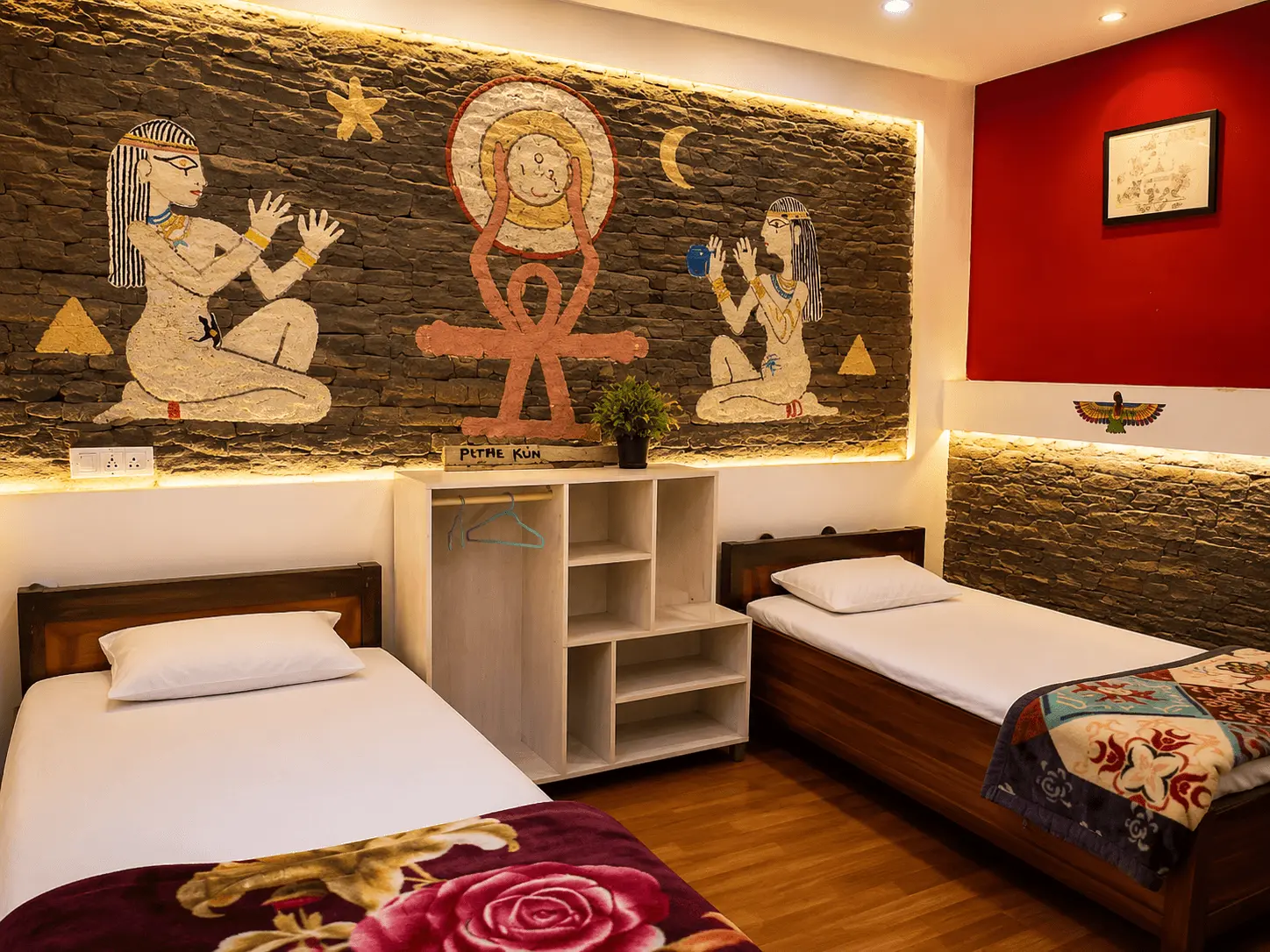
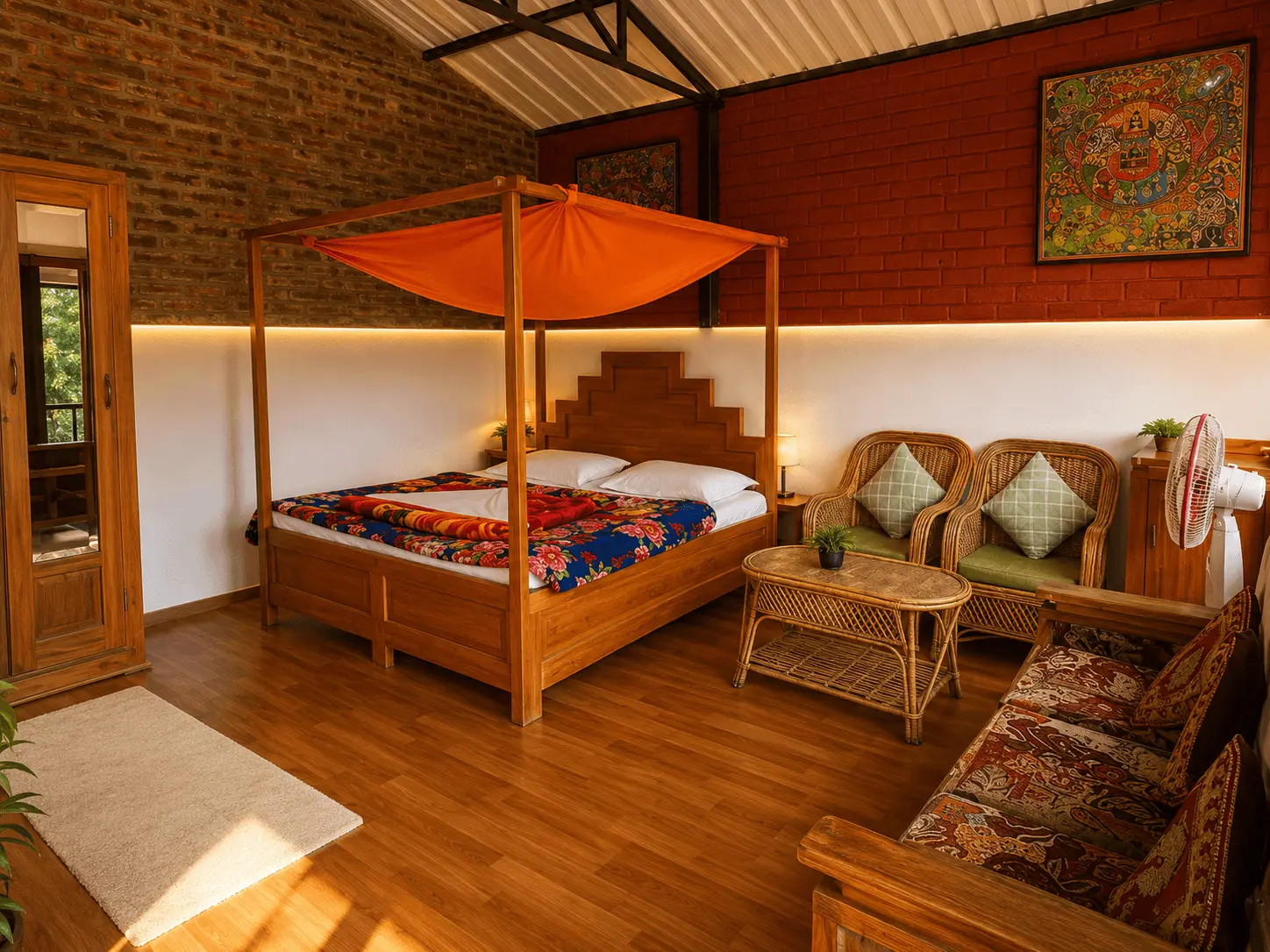
You live at Maunvan ashram for the entire 25 days. The ashram sits on a forested ridge above the Ganga valley — genuinely away from the noise and traffic of central Rishikesh town. Your room is your home for the month: simple, clean, well maintained, and built for sleep, study, and recovery rather than entertainment.
🛏
Private Single Room
Your own room for the duration of the training — the recommended choice for anyone who needs quiet space for self-study and rest between intensive sessions. Simply furnished with a comfortable bed, study area, storage, and either attached or shared bathroom.
🛌
Shared Room
Shared with one other course participant of the same gender. The more affordable option — same quality of space and the same access to all facilities. Many students find sharing with a fellow trainee deepens the community experience of the course.
🌿
Ashram Grounds
Forest paths, a meditation garden, and quiet sitting areas surround the rooms. Between sessions you can walk, journal, or simply sit in silence. The natural environment is part of the training — it is impossible to feel the full depth of what yoga is in an urban setting.
🚿
Clean Facilities
Hot water, clean shared or attached bathrooms, and regular housekeeping throughout your stay. The simplicity is intentional — a teacher training is not a luxury hotel experience, and everything about the living situation supports focus rather than distraction.
All accommodation is included in the course fee. Arrive at the ashram the evening before your batch start date — your room will be ready and you will meet the teachers and fellow students over dinner before the training begins the following morning.
Why Choose Maunvan for Your 200 Hour Yoga Teacher Training?
There are many schools offering 200 Hour TTC in Rishikesh. Here is what makes Maunvan different — not as marketing claims, but as specific decisions about how the program is run that directly affect the quality of what you learn.
12
Maximum 12 Students
This is not a cohort of 30 or 40 people. A maximum of 12 students per batch means your teacher knows your practice, your alignment issues, and your learning pace from day one. Teaching feedback is specific to you, not generic to the group. This is the single most important factor in the quality of a teacher training.
RYS
Yoga Alliance RYS 200 Registered
Maunvan is a Yoga Alliance Registered Yoga School. Your certificate from this program allows you to register as an RYT-200 — the credential that studios, gyms, and wellness centres in most countries recognise and require. The registration is not automatic; we guide you through the process as part of the course.
🕉
Experienced Traditional Teachers
Maunvan's resident teachers have decades of practice rooted in the classical Indian yoga tradition. They did not complete a 200 Hour weekend course and start teaching the following week. The depth of their practice shows in how they teach — and in the kind of teacher you become when trained by people who genuinely know the tradition.
ALL
Truly All-Inclusive Fee
One price covers 25 nights accommodation, all meals, every teaching session, all course materials, and certificate. No extras charged on arrival. No separate fee for anatomy books or Yoga Alliance registration support. What is quoted is what you pay, total.
🏔
Himalayan Ashram Setting
The environment shapes the training. Maunvan is on a forested ridge above the Ganga valley, away from central Rishikesh traffic and noise. Morning practice in this setting — before sunrise, surrounded by forest, with Himalayan ridges visible in the early light — is qualitatively different from a studio in an urban building.
👁
Personal Teaching Support
You lead practice sessions from week two. Each teaching session receives detailed written and verbal feedback from the resident teacher — not a checklist, but genuine pedagogical guidance on your cueing, sequencing, adjustments, and presence. By the end of 25 days you have taught multiple times and been assessed carefully each time.
What is the 200 Hour Yoga Teacher Training at Maunvan, Rishikesh, India?
A 25-day residential 200 Hour Yoga TTC in Rishikesh — Yoga Alliance RYS 200 registered, leading to RYT-200 certification. Covers Hatha yoga, Ashtanga, Pranayama, Anatomy, Philosophy, Sanskrit, and Teaching Methodology. Himalayan ashram setting in Rishikesh, India. Maximum 12 students per batch. Fully all-inclusive (accommodation, all meals, materials, certificate). Monthly batches all year. Starting from $1,050. Open to all levels with at least 6 months of regular yoga practice.
Frequently Asked Questions
Do I need experience to join the 200 Hour TTC in Rishikesh? +
You need basic yoga experience — ideally at least six months of regular practice. You do not need to be advanced or to be able to do advanced postures. If you can move through a basic asana sequence with some familiarity of breath and body awareness, you are ready. Complete beginners with no prior yoga experience at all are advised to first attend one of our shorter yoga retreats to build a foundation before applying to the TTC. This is not a gatekeeping measure — it is practical: the TTC curriculum moves at a pace that assumes some prior body-mind connection, and a total beginner will have a harder time keeping up and getting the most from the training.
Is the 200 Hour TTC at Maunvan Yoga Alliance certified? +
Yes. Maunvan is a Yoga Alliance Registered Yoga School (RYS 200). Graduates of our 200 Hour TTC receive a certificate that qualifies them to register as a Registered Yoga Teacher (RYT-200) with Yoga Alliance — the internationally recognised standard for yoga teacher certification. We guide each graduating student through the registration process as part of the course completion process.
How much does the 200 Hour Yoga Teacher Training cost? +
The 200 Hour TTC at Maunvan costs $1,200 for a single private room or $1,050 per person for a shared room. Both prices are all-inclusive — 25 nights of accommodation, all sattvic vegetarian meals throughout the course, every teaching session, all course materials and textbooks, and Yoga Alliance registration support. There are no hidden fees, no charges on arrival, and no optional extras that are actually required. What is quoted is the total cost of the program.
What certification do I receive after completing the 200 Hour TTC? +
You receive a 200 Hour Yoga Teacher Training Certificate from Maunvan Yoga and Wellness, a Yoga Alliance Registered Yoga School (RYS 200). With this certificate you can register as an RYT-200 with Yoga Alliance, which is recognised globally as the standard credential for yoga teachers. You can then teach yoga professionally in studios, gyms, retreat centres, spas, corporate settings, or independently anywhere in the world. The RYT-200 is also the prerequisite for advanced 300 Hour TTC programs.
What is the daily schedule like during the 200 Hour TTC? +
The schedule is intensive and structured. Each day begins at 5:30 AM with a 90-minute Pranayama and Meditation session, followed by 90 minutes of Hatha or Ashtanga asana practice, breakfast at 9:00 AM, then academic sessions covering Anatomy (10:00 AM) and Philosophy or Sanskrit (12:00 PM). After lunch and rest, afternoon sessions cover Teaching Methodology and peer teaching workshops (2:30 PM), afternoon Yin or restorative practice (4:00 PM), self-study time (6:00 PM), dinner (7:00 PM), and evening Satsang (8:00 PM). Lights out at 10:00 PM. The schedule runs six days a week with one rest day.
Can I teach yoga professionally after completing 200 Hours? +
Yes. A 200 Hour TTC is the globally recognised entry-level qualification for professional yoga teaching. With an RYT-200 credential from a Yoga Alliance Registered School like Maunvan, you can teach in yoga studios, gyms, wellness centres, corporate environments, schools, hospitals, or as an independent teacher anywhere in the world. Many yoga studios and fitness facilities require or prefer Yoga Alliance credentials when hiring teachers. The 200 Hour certificate is also the prerequisite for advanced 300 Hour specialisation programs, which lead to the RYT-500 credential.
What should I bring to the 200 Hour Yoga Teacher Training in Rishikesh? +
Bring comfortable, loose-fitting practice clothes suitable for morning and afternoon sessions (you will practice twice daily), a journal and pens for study notes and reflections, any prescription medications you need for 25 days, a warm layer for early morning practice (Rishikesh mornings can be cool even in warmer months — the pre-sunrise session at 6:00 AM is particularly cool), and any personal toiletries. Yoga mats, blocks, straps, and bolsters are provided at the ashram. All course textbooks are supplied as part of the fee. You do not need to buy special equipment. Arrive the evening before your batch start date so you can rest, meet fellow students, and be ready for the 5:30 AM wake-up on day one.
What is the difference between the 200 Hour and 300 Hour Yoga Teacher Training? +
The 200 Hour TTC is the entry-level foundation qualification — it covers all core subjects (asana, pranayama, anatomy, philosophy, teaching methodology) and leads to the Yoga Alliance RYT-200 credential. You must complete your 200 Hour TTC before you can enrol in a 300 Hour program. The 300 Hour TTC is an advanced program for teachers who already hold an RYT-200 certificate. It goes deeper into specific areas of practice and teaching, and when combined with your 200 Hour certificate, leads to the RYT-500 credential — the highest level of Yoga Alliance certification. Maunvan offers both programs; the 300 Hour TTC runs as a 30-day residential program at the same ashram.
What is the best time of year to do a 200 Hour TTC in Rishikesh? +
October through March is the best season for a 200 Hour TTC in Rishikesh. The weather during these months is cool and clear — ideal for early morning pranayama practice before sunrise and sustained intensive study throughout the day. December and January mornings are cold (between 5°C and 12°C) but the crisp mountain air and the quality of light are extraordinary, and every student who attends in these months considers the conditions part of what makes the training special. April through June is warmer but still manageable. July through September is monsoon season — the ashram is beautiful in the rain but the humidity makes sustained physical practice more demanding. Our October through March batches fill earliest, often 2–3 months in advance. If you can be flexible on timing, October, November, and February are particularly popular months.
How do I get to Maunvan ashram from Delhi or the nearest airport? +
From Delhi, the most comfortable route is by train to Haridwar (4–5 hours, multiple daily trains from Delhi stations including NDLS and H. Nizamuddin) followed by a 30-minute taxi to Maunvan in Tapovan, Rishikesh. Book the train in advance during peak season. Alternatively, Jolly Grant Airport (Dehradun) is 35 km from the ashram and has direct flights from Delhi (45 minutes, multiple daily). From Dehradun Airport a taxi to Maunvan takes about 45 minutes. You can also take an overnight Volvo bus from Delhi's ISBT Kashmere Gate directly to Rishikesh bus stand, which is about 20 minutes from the ashram by auto-rickshaw or taxi. We send complete travel directions, auto-rickshaw rates, and taxi contact numbers to all enrolled students 2 weeks before their arrival date.
Why is India — and Rishikesh specifically — the best place to do a 200 Hour Yoga TTC? +
India is where yoga originates. The classical texts — the Yoga Sutras, the Bhagavad Gita, the Hatha Yoga Pradipika — were written and practiced here. The teaching lineages that inform every credible 200 Hour TTC trace back to Indian teachers in the Indian tradition. Doing a 200 Hour Yoga Teacher Training in India means studying the subject in its source culture, with teachers whose practice is rooted in that tradition rather than adapted and exported. Rishikesh specifically has been a gathering place for yogis, sadhus, and serious practitioners for centuries. The Ganga descends from the Himalayas here. The pace, the environment, the presence of genuine practitioners — it all creates conditions that are genuinely conducive to the kind of deep, immersive study that a 200 Hour TTC requires. Beyond the tradition and setting, a 200 Hour Yoga TTC in Rishikesh, India also represents exceptional value — at Maunvan, the all-inclusive fee starts at $1,050 for 25 days, a fraction of what comparable programs cost in Europe, Australia, or the US, with greater depth of teaching and a more authentic immersive experience.
Page last updated:
Apply for the TTC
200 Hour Yoga Teacher Training — Maunvan, Rishikesh